Ridge vs Box Roof Ventilation in Coon Rapids 1983 Homes
If you own a 1983 home in Coon Rapids and you're choosing between ridge vents and box vents, ridge ventilation is generally the better option — but only when your soffit intake is balanced and your attic framing allows continuous airflow. Homes built in the early 1980s in Coon Rapids often have blocked soffit channels, low attic heel heights, or existing box vents that complicate a direct swap. The right choice depends on your attic square footage, how your original rafters were cut, and whether your current intake ventilation can support a ridge system.
What Is the Core Difference Between Ridge and Box Vents?
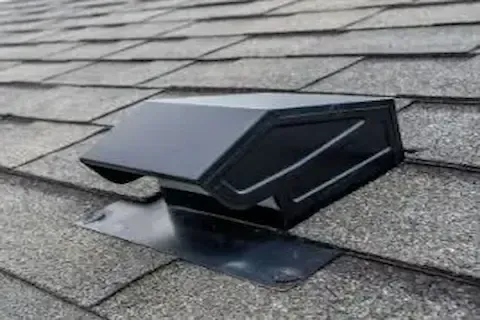
Ridge vents run along the full peak of your roof and exhaust heat continuously across the entire attic. Box vents — sometimes called static vents or turtle vents — are individual units cut into the roof deck at fixed intervals near the peak. Both are passive systems that rely on natural convection, but ridge vents distribute exhaust evenly while box vents create isolated exhaust points with gaps between them.
In a properly balanced system, ridge ventilation paired with continuous soffit intake consistently outperforms scattered box vents. However, a ridge vent installed without adequate soffit intake will underperform worse than a box vent setup that happens to have working intake channels.
Why Does the 1983 Build Year Matter in Coon Rapids?
Homes built around 1983 in Coon Rapids fall into a specific construction window. The Minnesota building code at that time did not require the same attic ventilation ratios enforced today. Many of these homes were built with low-profile rafter tails, minimal heel height at the eave, and fiberglass batt insulation pushed against the roof deck — all of which block airflow from soffit vents before it ever reaches the attic.
Coon Rapids also saw significant tract development during this period. Subdivisions off Highway 10 and near the Rum River corridor were framed quickly, and soffit vent placement was often inconsistent. If your home was built in this era, there is a reasonable chance your soffit channels have never been fully open, which affects which ventilation system will actually work.
For a deeper look at how early 1980s construction affects your attic system, review our resource on attic ventilation upgrades for older homes before making any ventilation decisions.
How Do You Know If Your Soffit Intake Is Adequate?
This is the most important question before choosing ridge versus box ventilation. The standard rule is one square foot of net free ventilation area for every 150 square feet of attic floor space, split evenly between intake and exhaust. If your soffit intake is blocked, insufficient, or non-functional, adding ridge vents will not help — and can actually create negative pressure that pulls conditioned air from your living space into the attic.
Signs that your 1983 Coon Rapids home may have inadequate soffit intake include:
Ice dams forming at the eave line every winter
Excessive attic heat in summer even with existing box vents
Insulation visible at the soffit edge with no baffles
No visible perforations or vent openings along the soffit panel
A roofer inspecting your attic should check the heel height at the eave, confirm baffles are present, and verify net free area before recommending ridge ventilation.
When Does a Box Vent System Make More Sense?
Box vents remain a practical choice in specific situations common to 1983 Coon Rapids homes. If your attic has multiple valleys, hips, or dormers that interrupt a continuous ridge, ridge venting cannot run the full length of the peak and will leave dead zones. Box vents placed strategically can cover irregular attic geometries more effectively in these cases.
Box vents also make sense when a re-roof budget is limited. Replacing existing box vents in kind during a shingle replacement costs less than cutting a new continuous ridge slot, installing a ridge vent product, and ensuring soffit baffles are in place. If your current box vents are functional and your soffit intake is working, keeping that system during a re-roof is a defensible decision.
Our Attic Ventilation service page covers the full scope of what a professional ventilation assessment includes and what corrections typically involve for homes in this area.
What Are the Common Mistakes With Mixing Vent Types?
One of the most consistent ventilation errors in Coon Rapids homes is mixing ridge vents with existing box vents and leaving both active. When you install a ridge vent but leave old box vents open below the ridge line, the ridge vent exhausts through the path of least resistance — which is often the nearest box vent rather than the soffit intake below. This short-circuits airflow and leaves most of the attic unventilated.
If you install ridge ventilation, existing box vents near or at the same elevation as the ridge must be permanently closed. This is a standard step that is sometimes skipped during quick re-roof jobs, particularly when homeowners assume more vents equals more ventilation. It does not. Balanced, directional airflow from soffit to ridge is the goal.
What Should You Ask a Roofer Before Any Ventilation Work?
When getting bids for ventilation work on your Coon Rapids home, ask these specific questions before agreeing to any approach:
Will you measure my current net free area at the intake and exhaust?
Are baffles present at every rafter bay, and if not, will that be corrected?
If you install ridge vents, will existing box vents be sealed?
Does my attic geometry support continuous ridge ventilation, or are there interruptions?
What ventilation ratio will I achieve after this work, and does it meet current Minnesota code?
A contractor who cannot answer these questions specifically is not approaching your attic as an integrated system. Ventilation decisions on 1983 Coon Rapids homes require knowledge of both the original construction standards and current Minnesota requirements — the gap between those two is where most problems originate.
Closing Perspective
Ridge ventilation outperforms box vents in most scenarios, but not in all. For a 1983 Coon Rapids home, the honest answer depends on your soffit intake condition, your attic framing, and your roof geometry. Getting that assessment done before committing to either system is the only way to make a decision that will actually perform through Minnesota winters and summers.
