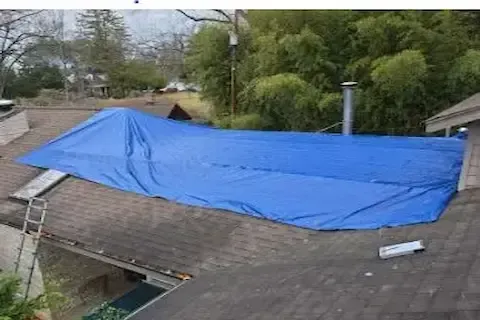
Coon Rapids Emergency Tarp and Board Up After Storms
After a storm tears through Coon Rapids, getting a tarp over a damaged roof or boarding up broken windows within the first few hours is the single most important step you can take. Emergency tarp and board-up service stops active water intrusion, protects your belongings, and keeps your homeowner's insurance claim intact. Insurers in Minnesota expect you to mitigate further damage immediately after a storm event. Waiting even 24 hours can mean secondary water damage that adjusters classify as preventable — and that distinction costs you money. Coon Rapids homeowners have options for fast, professional response when storms strike.
What Does Emergency Tarp and Board-Up Actually Cover?
Emergency tarp and board-up is a temporary protective service, not a permanent repair. When a severe storm moves through the Coon Rapids area — whether it brings straight-line winds, large hail, or a fast-moving tornado track — it can punch holes through roof decking, shatter windows, or tear off entire sections of soffit and fascia. A trained crew arrives with heavy-duty polyethylene tarps, dimensional lumber, and fastening systems designed to hold against additional wind and rain until permanent repairs can be scheduled. The service typically covers open roof sections, broken skylights, damaged gable ends, and any exterior opening that exposes interior structure to the elements.
Why Does Speed Matter So Much After a Coon Rapids Storm?
Minnesota weather does not pause for recovery. A storm that passes through Coon Rapids on a Tuesday afternoon can be followed by another rain system by Thursday. Once roof decking is exposed, water infiltrates insulation, flows down wall cavities, and reaches subfloor systems within hours — not days. Mold can begin colonizing wet cellulose insulation in as little as 48 hours when summer humidity is elevated, which is common along the Mississippi River corridor that runs through Anoka County. The faster a tarp is secured, the smaller the total damage footprint, and the simpler your insurance claim becomes.
How Does Emergency Tarp Service Protect Your Insurance Claim?
Most homeowner's insurance policies in Minnesota include a duty-to-mitigate clause. This means you are required to take reasonable steps to prevent additional damage after a covered event. If an adjuster documents that a roof opening was left exposed for several days and secondary water damage resulted, that secondary damage can be excluded from the claim or reduced significantly. A professional Emergency Roof Repair and tarp installation creates a documented record — timestamped photos, a signed work order, and a clear scope of what was protected and when. That paperwork becomes part of your claim file and supports full reimbursement.
What Should You Expect During a Board-Up or Tarp Installation?
A professional crew will first perform a visual safety assessment before stepping onto any damaged structure. Weakened decking, compromised rafters, or unstable chimney sections must be identified before anyone climbs. Once the work zone is confirmed safe, the crew measures and cuts tarps to overlap the ridge by at least two feet on each side, then secures them with batten boards screwed through the tarp into solid decking — not just draped loosely over the roof. For window and door board-up, plywood panels are cut to fit and secured with structural screws rather than nails, which hold better against wind pressure common in the open neighborhoods north of Highway 610 in Coon Rapids.
Are There Situations Where Tarping Is Not Enough?
Yes. If structural rafters or load-bearing walls are compromised, temporary tarping buys time but does not restore structural integrity. In those cases, emergency shoring may also be required. Homeowners in older Coon Rapids neighborhoods — particularly those with homes built before 1980 — sometimes discover that storm damage reveals underlying issues like deteriorated decking or undersized rafter spans that were already marginal. A professional crew will flag these conditions and document them separately so your adjuster has complete information. Tarping over a structurally questionable section without noting it creates risk for everyone involved, including your family if the home is occupied during the wait for permanent repair.
How Do You Find a Trustworthy Emergency Tarp Crew in Coon Rapids?
After major storms, storm-chasing contractors flood the Coon Rapids and broader Anoka County market within 24 to 48 hours. Some are legitimate operations from neighboring communities. Others are transient crews with no local license, no insurance, and no warranty. The practical way to filter quickly is to ask for a Minnesota contractor license number, verify it takes less than two minutes on the Department of Labor and Industry website, and ask whether the crew carries general liability coverage specific to roofing operations. A company with a physical presence in the northwest metro will have a verifiable address and a service history you can check through Anoka County building permit records if needed. For broader context on what professional storm response looks like from initial assessment through documentation, read this guide on emergency post-storm repair help that walks through the full process.
What Does Emergency Tarp and Board-Up Typically Cost?
Costs vary based on the size of the opening, roof pitch, and accessibility. A single small penetration on a low-slope roof may run a few hundred dollars in materials and labor. A large open section on a steep-pitched roof in a two-story home can reach into the low thousands. Most homeowner's insurance policies cover emergency mitigation costs as part of the claim, separate from the repair itself, so out-of-pocket exposure is often minimal when a claim is filed. Keep every receipt, photograph every tarp or board installed, and request a written scope from the crew before work begins. That documentation is what your adjuster needs to process reimbursement cleanly.
What Happens After the Tarp Is Installed?
Tarping is a temporary measure with a limited effective lifespan, typically 30 to 90 days depending on UV exposure and wind conditions. Once your insurance adjuster completes their inspection and your claim scope is approved, permanent repair should begin as quickly as possible. The tarp installation creates a stable window of time for that process to happen properly — complete material selection, permit pulling if required by the City of Coon Rapids, and scheduled installation rather than emergency patchwork. Homeowners who use that window wisely end up with a better permanent repair than those who skip temporary protection and attempt to rush a permanent fix under pressure.
